2025 AHA ECC Guidelines – Part 2
The American Heart Association (AHA) Emergency Cardiovascular Care (ECC) Guidelines have been updated for 2025. As a trusted provider of ACLS , BLS , and PALS certification, we’ve been busy preparing to roll out training on these new recommendations in accordance with the guidelines’ designated schedule.
We covered some of the newest guidelines in Part 1 of this series , including the new unified chain of survival and special circumstances for resuscitation.
Below, we’ll give you a sneak peek at some of the other changes and updates that will be making their way into our certification courses!
Important : This article provides a general overview of selected updates to the 2025 American Heart Association CPR and ECC Guidelines and is for informational purposes only. It is not a substitute for formal training, professional medical guidance, or the complete AHA Guidelines. Always follow your organization’s protocols, applicable requirements, and current guidance from the appropriate medical authorities.
Update: Telecommunicator-Assisted CPR (T-CPR)
The 2025 guidelines provide updated recommendations for telecommunicators (i.e., dispatchers) to provide separate sets of instructions for adult CPR versus child CPR.
Lay rescuers should be guided through hands-only CPR for adults but standard CPR (including breaths) for children.
Emergency telecommunicators are also instructed to assume that the patient is in cardiac arrest if they are described as unresponsive with abnormal, agonal or absent breathing (known as the No-No-Go process).
Other Updates to Adult Basic Life Support (BLS) Recommendations
We discussed some aspects of the updated adult BLS recommendations in part 1, including the integration of naloxone for suspected opioid overdose, the scaled-down use of mechanical CPR devices, and the updated algorithm for foreign body airway obstruction (FBAO).
However, these were not the only updates to basic life support for 2025. Other recommendations include:
- Airway Management in Head and Neck Trauma . Jaw thrusts and airway adjunct insertion are still preferred in cases of head and/or neck trauma, but the guidelines emphasize the priority of opening the airway. When jaw thrust and airway adjunct insertion fail, the head tilt-chin lift technique should be used to ensure a patent airway for oxygenation and ventilation.
- Effective Ventilation . The new guidelines emphasize the importance of avoiding hypo- or hyperventilation by ensuring that ventilation results in a visible chest rise and by providing two breaths for every 30 compressions.
- Defibrillation Pad Placement for Women . Women experience significantly lower rates of public-access defibrillation, possibly as a result of rescuers’ discomfort with exposing a woman’s chest. As a result, guidelines now suggest that it may be reasonable to adjust the position of the bra and other clothing for defibrillation instead of removing it.
- CPR and Obesity . The guidelines affirm that adults with obesity should be given CPR with the same techniques used for those without, based on research finding no evidence to support the need for changes from standard CPR. Nonetheless, the guidelines still stipulate that it may be reasonable to increase the force of compressions to achieve adequate depth in adult obese patients.
Other Updates to Pediatric Basic Life Support Recommendations
We touched on updated recommendations to the FBAO algorithm for infants in part 1, but as with adult recommendations, the 2025 guidelines have many other pediatric updates. We’ll discuss a few of the key takeaways below.
Key updates include:
- Minimizing Pauses in CPR . Pauses in CPR for children and infants should be minimized and limited to 10 seconds or less in duration.
- Infant Compression Technique . The 2-finger technique is no longer recommended for infant CPR. Instead, rescuers should compress the sternum with the heel of one hand or – if the child is small enough – use the 2-thumb encircling hands technique. Research indicates that these provide adequate compression, while the 2-finger technique does not.
Update: Neonatal Chain of Care
While the 2025 AHA ECC guidelines unified all adult and pediatric chains of care into a single model, there is still one population that has a separate chain of care: newborns.
The newborn chain of care is as follows:
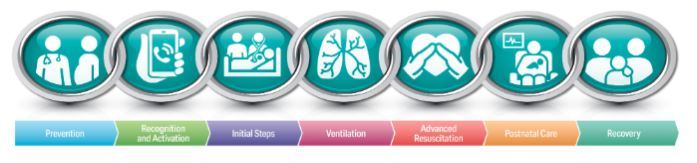
The distinction from the unified chain of care lies in a few places:
- Prevention through prenatal and antenatal care which extends to recovery and appropriate follow-up.
- Recognition of risk and anticipation of the need for assistance both individually and as teams.
- Additional “initial steps” necessary for newborns include:
- Drying and warming
- Delaying the clamping of the umbilical cord for at least 60 seconds during evaluation, tactile stimulation, and airway clearing
- Maintaining skin-to-skin contact and monitoring of breathing and temperature for at least an hour, whenever possible.
Update: Post-Cardiac Arrest Care & Specialized Centers
The 2025 AHA ECC Guidelines note that long-term outcomes for cardiac arrest survivors would benefit from integrated systems to assess patients before discharge, reassess their needs after discharge, and address needs on an ongoing basis.
This would require coordinating multidisciplinary teams, including providers in- and out-of-hospital.
Update: Equity and Global Implementation
For the first time, the 2025 AHA ECC guidelines focus on actively addressing health equity to eliminate disparities in cardiac arrest and emergency cardiovascular care.
While the topic appears most prominently in the ethics section for the moment, health equity makes its way into other aspects of the updated guidelines. For example, centers with extracorporeal cardiopulmonary resuscitation (ECPR) like ECMO are encouraged to develop and frequently reassess patient selection criteria, in part to ensure more equitable access to the technology.
Health equity also makes its way into the recommendations for data collection, outcome metrics, and system-based measurements, as we’ll see next. This ensures that health equity goals can become more informed and concrete in future ECC updates.
2025 ECC Implementation Timeline & Training Materials
The 2025 AHA ECC guidelines were released in October of 2025, with a 90-day transition period to allow instructors like us to integrate the new recommendations into training materials.
By March 1, 2026, all ECC courses must be aligned with the updated 2025 guidelines in order to continue teaching AHA courses like BLS, ACLS, and more.
If you obtained BLS, ACLS, or PALS certification between October 22, 2025, and March 1, 2026, be sure to check whether the course you took was updated with the most recent guidelines to ensure compliance.
Explore Online Healthcare Training
Stay current with evolving emergency cardiovascular care guidance and continue building your professional knowledge with flexible online training. Explore our course catalog to find training options that fit your role, professional goals, and schedule. Enroll today!